
Bambu Lab’s new X2D has generated a huge amount of hype, and on paper it looks like the next evolution of high-speed consumer 3D printing. But once you move beyond the marketing, the reality is that for most makers, hobbyists, and even small businesses, the Bambu Lab P2S is still the smarter buy.
The P2S hits the sweet spot of price, reliability, print quality, and ease of use — and for around 80–90% of people, it’s realistically all the printer they’ll ever need.
So where does that leave the X2D? And is it actually worth the premium?

The Bambu Lab P2S: The Better Value for Most People
The biggest advantage of the P2S is simple: value.
Bambu Lab has refined its ecosystem to the point where the P2S delivers:
- Excellent print quality
- Fast print speeds
- Reliable multi-colour support
- Easy setup and maintenance
- Strong software integration
- And a low price point
For hobbyists printing:
- Functional parts
- Cosplay props
- Miniatures
- Household items
- RC parts
- And prototyping components
…the P2S already does nearly everything exceptionally well!
Most users are not running print farms or producing engineering-grade multi-material assemblies every day. They want a printer that works reliably, prints fast, and doesn’t require constant tuning. That’s exactly where the P2S shines.
The reality is that the majority of users will never fully utilize the extra complexity and cost of the X2D.

The Bambu Lab X2D Isn't a True Dual-Nozzle System
One of the biggest misconceptions about the X2D is that it’s a “true” dual-nozzle printer comparable to professional systems like the Bambu Lab H2D or toolchanger designs.
It isn’t.
The X2D uses:
- One direct-drive extruder
- And one Bowden-driven auxiliary extruder
That distinction matters a lot.


A true independent dual-nozzle or dual-direct-drive system gives both nozzles equal performance characteristics. The X2D does not.
Because the secondary nozzle is Bowden-fed, it introduces:
- Less extrusion precision
- Slower material response
- Reduced retraction accuracy
- And more inconsistency with flexible or demanding filaments
In practical use, this means the auxiliary nozzle is best suited for:
- Support material
- Breakaway supports
- Soluble supports
- And occasional secondary colour use
So while the X2D can absolutely reduce purge waste compared to AMS-only systems, buyers should understand that its second nozzle is not designed to deliver the same print quality as the main direct-drive nozzle.
That makes the X2D very different from genuinely high-end dual extrusion systems or toolchanger platforms.

The Better Alternative for Serious Multi-Material Printing: Flashforge Creator 5 Pro?
If your primary goal is:
- True multi-material printing
- Dramatically reduced purge waste
- And reliable multi-colour output
…then the more interesting option may actually be the Flashforge Creator 5 Pro.
Instead of using an auxiliary support-focused nozzle, the Creator 5 Pro uses a 4 tool-changer system.

That means:
- Each material has its own dedicated toolhead
- No constant filament swapping
- Significantly less waste
- Cleaner colour transitions
- And better material isolation
For users serious about:
- Multi-colour production
- Soluble supports
- Advanced material combinations
- Professional workflows
…the Creator 5 Pro is arguably a more compelling direction than the X2D.
Toolchanger systems are simply a more elegant solution for multi-material printing than hybrid extruder setups.
Final Thoughts
The X2D is an impressive machine, but it also feels like a printer aimed at a relatively niche audience.
For most people, the Bambu Lab P2S remains the better purchase because it offers:
- Outstanding print quality
- Fast speeds
- A low cost
- Fewer compromises
And most importantly: it already does almost everything most users need.
The X2D’s auxiliary Bowden-fed nozzle also means it shouldn’t be mistaken for a true high-performance dual-nozzle system. It’s best viewed as a support-focused secondary extrusion setup rather than equal-performance dual extrusion.
If you genuinely need advanced multi-material workflows with minimal waste, then systems like the Flashforge Creator 5 Pro and its 4-toolchanger system may actually represent the more exciting future of consumer multi-material printing.
For everyone else? The P2S is probably still the smarter buy.
 Bambu Lab X2D 3D Printer -
  Bambu Lab P2S 3D Printer -
 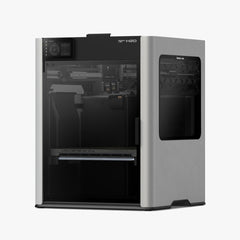 Bambu Lab H2D 3D Printer -
  Flashforge Creator 5 Pro 3D Printer -


